
By the end of July, a bicycle has often covered plenty of commuting, shopping and leisure kilometres. In Jyväskylä, cycling works well for short everyday trips, and according to the city, more than half of its residents live less than five kilometres from the city centre. As the kilometres add up, brakes, tires and the drivetrain wear too. (City of Jyväskylä)
A small change in how a bicycle works does not always mean a major fault. It is still worth checking early, before a simple adjustment turns into a more expensive repair or a safety risk.
1. The brakes feel weaker than usual
The brakes should work evenly and bring the bicycle to a predictable stop. Signs that service may be needed include:
- the brake lever pulls almost to the handlebar
- stopping distance has increased
- the brakes squeal continuously
- a brake rubs while riding
- one brake works clearly worse than the other
You can check the brakes safely by walking the bicycle and testing the front and rear brakes separately. The brakes should stop the bicycle firmly without the lever pulling all the way to the handlebar. Basic pre-ride checks also recommend making sure that both brakes work smoothly. (REI)
Do not ride in traffic if a brake does not hold properly, the lever feels unusually soft or a brake component is visibly damaged. Cable, brake pad and hydraulic brake repairs are best left to a professional unless you know the particular brake system well.
2. A tire loses air or looks worn
Tire pressure gradually drops even in an undamaged tire. If a tire becomes soft quickly, the cause may be a punctured inner tube, a valve fault or a sharp object left in the tire.
Check before riding:
- whether both tires feel sufficiently firm
- whether the outer tire has cuts, bulges or cracks
- whether the tread is clearly worn smooth
- whether the valve is straight
- whether you can hear air escaping
The correct tire pressure is usually marked on the sidewall. Do not automatically inflate a tire as hard as possible; choose a pressure within the range specified by the tire manufacturer. (REI)
Do not use the bicycle if the tire has a bulge, the casing is visible through the surface or the tire will not hold pressure. Repeated punctures should also be investigated, as the problem may be in the outer tire, rim tape or rim.
3. The gears skip or shift slowly
A properly working drivetrain should move the chain to the next cog without a long delay, loud grinding or a sudden loss of resistance at the pedals.
Signs that service may be needed include:
- the chain jumps over a cog while pedalling
- a gear does not shift on the first input
- the drivetrain keeps clicking or rattling
- the chain falls off the front or rear cogs
- the shifter feels unusually stiff
You can test the gears in a calm and safe place. Shift one gear at a time and avoid pushing hard on the pedals while shifting. If the chain moves unevenly or tries to fall outside the cogs, avoid continuing a long ride.
Inaccurate shifting can be caused by adjustment, a dirty drivetrain, worn components or a bent derailleur hanger. Shimano recommends having the bicycle checked if shifting becomes inaccurate or the chain repeatedly falls off. (Shimano Bike)
4. The chain squeaks, rusts or looks dry
A chain collects dust, grit and moisture while riding. A dirty or dry chain can start to squeak, shift poorly and wear the cogs faster than usual.
You can check whether:
- the chain looks dry or rusty
- there is a thick black layer of dirt on it
- the chain links move smoothly
- there is continuous squeaking while pedalling
- the chain jumps when you pedal harder
A lightly dirty chain can be wiped clean and lubricated with oil intended for bicycle chains. Wipe off excess oil so that the chain does not collect more dirt. Regular cleaning and lubrication help the drivetrain work better and last longer. (Shimano Bike)
Chain wear cannot be assessed reliably from appearance alone. Accurate measurement is done with a chain wear gauge. A worn chain used for too long can damage the cogs, turning a simple chain replacement into a larger repair. (Park Tool)
5. The bicycle has a new clicking, rattling or grinding noise
Not every noise means immediate danger, but a new or worsening sound should always be located.
Typical signs include:
- a click that follows the rhythm of pedalling
- grinding while a wheel is turning
- a metallic rattle over bumps
- squeaking from the handlebar or front end
- a strong new sound while braking
First check that nothing on the rack, mudguards, lock or bottle cage has come loose. You can also spin the wheels by hand and listen for the tire or brake touching something.
Do not start tightening random bolts without the correct tools and the manufacturer’s torque values. The sound may come from a bearing, bottom bracket, headset, spoke or drivetrain. If the source is not easy to identify, have the bicycle checked.
6. The bicycle feels heavy or unstable to ride
If a familiar bicycle starts to feel slow, heavy or difficult to control, the cause is not necessarily your fitness. Possible causes include:
- tire pressure that is too low
- a rubbing brake
- a wheel that is crooked or does not spin freely
- a loose headset
- worn wheel bearings
- a tire or wheel that is not seated correctly
Lift the front and rear of the bicycle in turn and spin the wheels by hand. They should rotate fairly freely without strong side-to-side movement or continuous rubbing.
Hold the front brake and gently move the bicycle back and forth. If you feel clear play or a knock around the handlebar or fork, the bicycle should be checked.
Do not ride if the steering feels loose, a wheel wobbles strongly or the bicycle pulls uncontrollably to one side.
7. Bicycle components are loose or damaged
Inspect the bicycle in good light. Pay particular attention to the frame, fork, wheels, handlebar and pedals.
A professional inspection is needed if you notice:
- a crack or dent in the frame
- a bent rim
- a broken or very loose spoke
- a pedal or crank that moves or wobbles
- a loose handlebar
- a damaged fork
- a tire or another component rubbing against the frame
Routine bicycle safety checks recommend regularly checking the condition and attachment of the tires, brakes, gears, chain, cranks and headset. (Cycling UK)
If the frame or fork was damaged in a fall or collision, do not ride before a professional has assessed it.
A practical checklist before your next ride
Do this quick check:
- Squeeze both tires and look for visible damage.
- Test the front and rear brakes while walking the bicycle.
- Spin both wheels and listen for rubbing sounds.
- Check whether the chain is dry, rusty or very dirty.
- Test the gears in a calm area.
- Make sure the handlebar, saddle and pedals do not move.
- Listen for new sounds.
- Stop riding if you have doubts about the brakes, steering or wheel attachment.
Bicycle service without an appointment in Seppälä, Jyväskylä
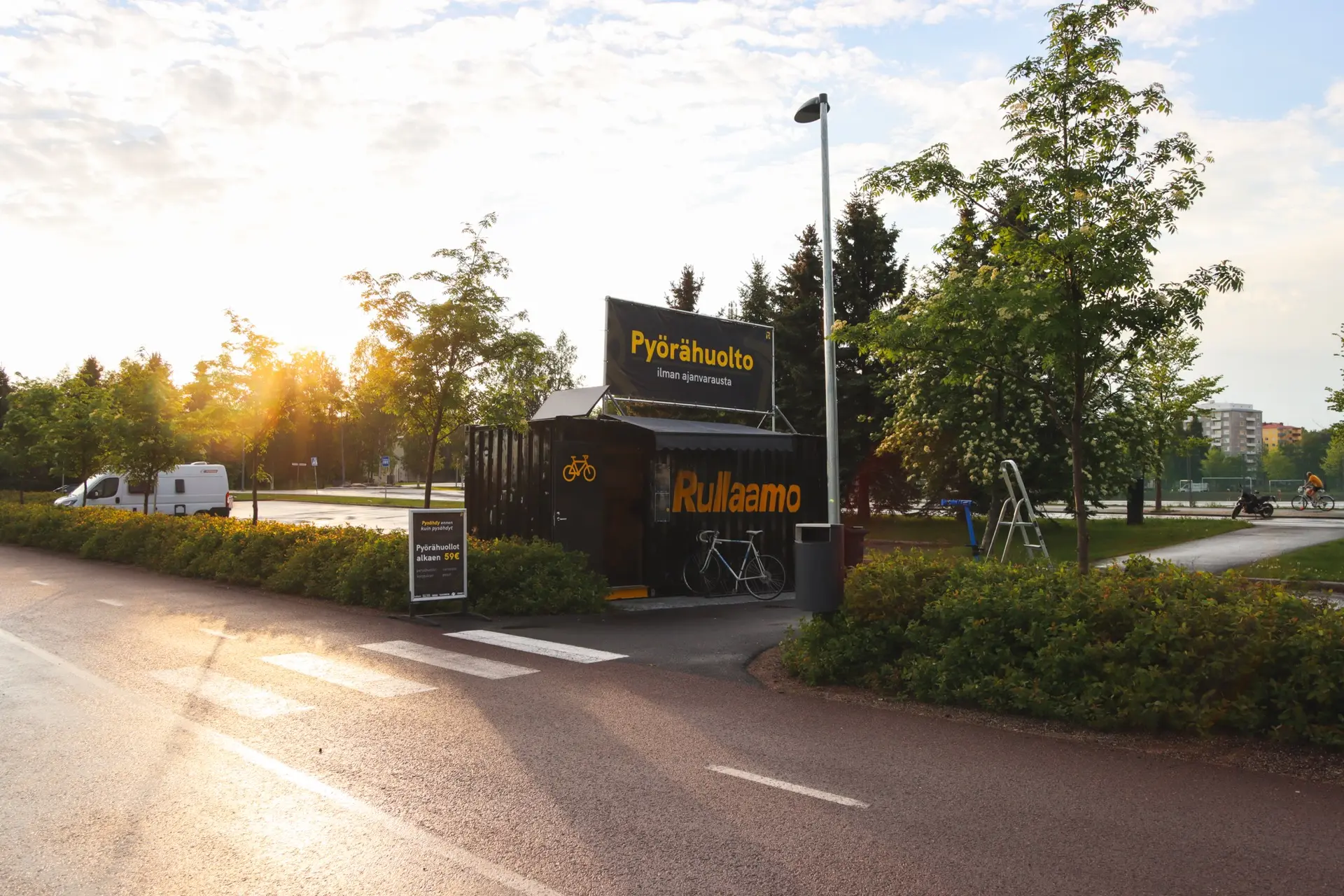
If a bicycle fault does not become clear during a basic check, or riding feels uncertain, you can bring the bicycle to the Rullaamo Jyväskylä service point without an appointment.
Rullaamo’s container is in the Seppälä K-Citymarket parking area at Vasarakatu 29, 40320 Jyväskylä. We confirm the price before starting work.
Rullaamo performs mechanical service work on regular bicycles and mechanical work on e-bikes. We do not service e-bike electrical or electronic components or suspension systems.
The service point is open Monday to Friday from 9:00 to 17:00 and closed on Saturdays and Sundays. Check the current services and prices on Rullaamo’s Jyväskylä page before visiting.
Do not wait until a small fault stops the bicycle completely. Walk in, explain what you have noticed and ask for a service assessment before your next longer ride.
Sources
- City of Jyväskylä: Walking and cycling
- City of Jyväskylä: Walking and cycling promotion programme
- Cycling UK: Guide to simple cycle safety and service checks
- REI: Bike Maintenance Basics
- REI: Pre-Ride Bike Inspection Checklist
- Park Tool: When to Replace a Worn Chain
- Park Tool: Tire and Tube Removal and Installation
- Shimano: Caring for Your Bike
- Shimano: A Clean Chain Is a Fast Chain
- Rullaamo Jyväskylä